
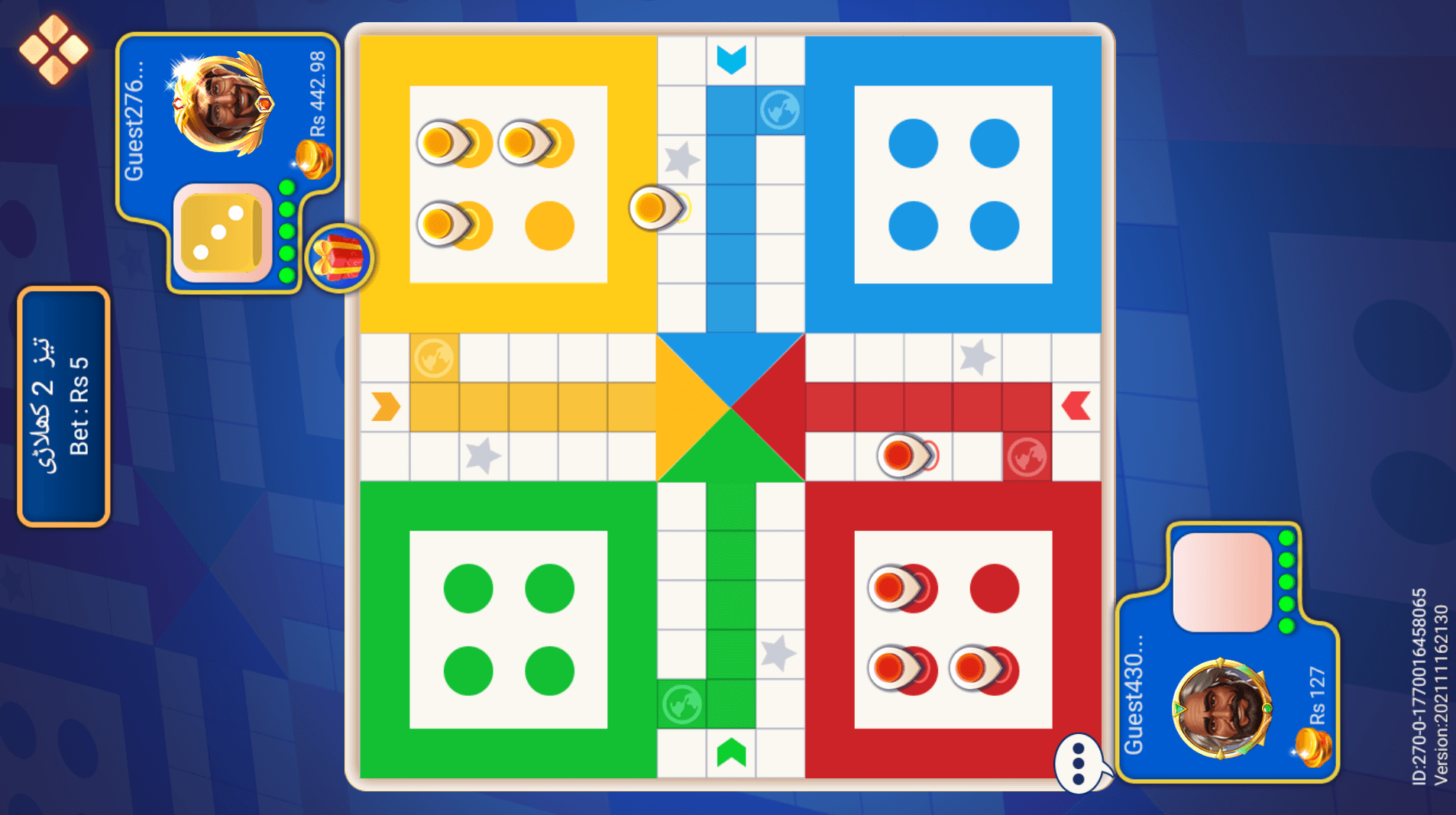
What Is Ludo?
Ludo is a 2 to 4-player race game played on a cross-shaped board. Each player controls four tokens of one colour and races them from their starting yard, around the track, and into the central home column. The first player to bring all four tokens home wins the round.
The game has South Asian origins — it descends from Pachisi, a board game played in India for over 1,500 years. Ludo became the simplified, dice-based modern version we know today in 19th-century England, and it remains one of the most-played family games in Pakistan, India, Bangladesh and across South Asia.
On LudoVegas, classic offline Ludo is upgraded into a fast, online, real-money experience: anti-cheat dice, smart matchmaking, multiple game modes and instant Easypaisa / JazzCash withdrawals. You can play casually with friends in a private room, or compete in cash tables and tournaments where the winner takes the prize pool.
LudoVegas vs Traditional Ludo — What's Different?
If you've only ever played Ludo on a paper board with a plastic dice cup, the LudoVegas version will feel familiar but more polished. Here's what's the same and what's different:
| Aspect | Traditional Ludo | Ludo on LudoVegas |
|---|---|---|
| Board & rules | Standard 15×15 cross board | Same standard board, identical rules |
| Dice | Physical six-sided die | Certified RNG (random number generator), provably fair |
| Start condition | Roll a 6 to leave home | Roll a 6 to leave home (same) |
| Players | 2–4 friends in the same room | 2 or 4 players matched online or invited friends |
| Game length | 15–30 minutes | Classic: 8–12 min · Quick: 4–6 min · 2P: 5–8 min |
| Turn timer | None — players can stall | Auto-skip if you don't roll within ~15 seconds |
| Stakes | Pride / friendly bets | Free chips OR real money via Easypaisa & JazzCash |
| Anti-cheat | Trust your friends | Server-side dice + behaviour detection |
Important: The rules are the same
LudoVegas does not change the core rules of Ludo. If you know how to play Ludo at home, you already know how to play on LudoVegas. The dice are random, you still need a 6 to start, three 6s in a row still cancel the turn, and capturing an opponent's token still sends it back to its yard.
Board Layout & Setup
The Ludo board is a cross (+) shape on a 15×15 grid with four coloured corners. Understanding the board is the foundation of every good Ludo decision.
Key Areas of the Board
- Yards (Bases): The four coloured corners — Red, Green, Yellow and Blue. Each player starts with all 4 tokens here.
- Starting Square: The first square on the main track that your tokens enter once they leave the yard. It's a permanent safe square.
- Main Track: 52 squares forming the loop around the board.
- Star (Safe) Squares: 8 squares marked with a star (★). A token on a star square cannot be captured.
- Home Column: The coloured arrow path leading into the centre. Only your own tokens can enter your home column. No captures happen here.
- Home (Centre): The triangular centre — the finish line. A token must roll the exact number to land here.
Setup on LudoVegas
- Open the LudoVegas app and tap Ludo from the lobby.
- Choose 2-Player or 4-Player, and pick a mode (Classic, Quick or Tournament).
- Pick an entry fee — free chips for practice or PKR cash tables for real money.
- The game auto-matches you with players of similar level, or you can host a private room and share a code with friends.
- Turn order is decided automatically (highest dice roll goes first).
Complete Ludo Rules — Step by Step
1. The Goal
Move all four of your tokens from your yard, around the full track, and into your home (centre) before the other players. The first to complete this wins the round (or in Quick mode, the first to bring just one token home wins).
2. Rolling and Moving
- On your turn, the dice rolls automatically (or you tap to roll). The result is a number from 1 to 6.
- You may move any one of your eligible tokens that number of squares forward.
- If you have multiple tokens on the board, you choose which one moves — this is where strategy matters most.
3. Leaving the Yard
- To bring a token out of your yard, you must roll a 6.
- Rolling a 6 also gives you a bonus roll.
- If you roll three 6s in a row, the third 6 is forfeited and your turn ends — this prevents one player from dominating.
4. Capturing Opponent Tokens
- If your token lands on a square already occupied by a single opponent token (and it's not a star/safe square), you capture it — the opponent's token returns to their yard.
- A successful capture grants you a bonus roll.
- Two of your own tokens on the same square form a block — opponents cannot pass through, and you cannot be captured. Some tournament modes disable blocking; check the rule panel.
5. Safe Squares
Eight squares on the board are marked with a star (★). A token on a star square is immune from capture. Each player's starting square is also a safe square. Safe squares are crucial defensive resting points — use them whenever an opponent's token is within a 6-square strike distance.
6. Entering Home
- Once your token completes the loop, it enters your home column.
- To finish, you need an exact roll. If your token is 3 squares from home and you roll a 5, you cannot move that token — you must move another, or skip.
- Each token that reaches home is a step closer to victory.
7. Winning
The first player to bring all four tokens into home wins (Classic mode). In Quick mode, only the first token home is needed. In tournament brackets, multiple matches are played and the points winner advances.
Game Modes on LudoVegas
One of the biggest reasons to play Ludo on LudoVegas instead of a generic offline app is variety. Each mode rewards a different style of play:
| Mode | Players | Win Condition | Avg Length | Best For |
|---|---|---|---|---|
| Classic 4P | 4 | All 4 tokens home | 8–12 min | Traditional fans, deep strategy |
| Classic 2P | 2 | All 4 tokens home | 5–8 min | Faster, head-to-head skill |
| Quick (Speed) | 2 or 4 | First token home wins | 4–6 min | Aggressive, high-volume players |
| Tournament | 16 / 32 / 64 | Knockout brackets | 30–60 min | Large prize pools, skill-based |
| Private Room | 2–4 | Custom rules | Varies | Friends & family |
Real Money Entry Fees & Prize Pool
LudoVegas offers Ludo at multiple stake levels so beginners and high-rollers both have a comfortable entry point. Here's how the cash tables typically work in Pakistan:
| Stake Tier | Entry Fee (per player) | Total Pool (4P) | Winner's Take (approx) |
|---|---|---|---|
| Beginner | Rs 10 – Rs 50 | Rs 40 – Rs 200 | Rs 36 – Rs 180 |
| Casual | Rs 100 – Rs 500 | Rs 400 – Rs 2,000 | Rs 360 – Rs 1,800 |
| High Stakes | Rs 1,000 – Rs 5,000 | Rs 4,000 – Rs 20,000 | Rs 3,600 – Rs 18,000 |
| Tournament | Rs 50 – Rs 1,000 | Up to Rs 100,000+ | Top 3–10 share prize pool |
How does the platform earn?
LudoVegas takes a small rake / table fee (usually around 10%) from the prize pool. The rest goes to the winner. Exact amounts are always displayed on the table preview before you join, so there are never any hidden charges.
Dice Probability — The Math Behind Ludo
Ludo feels random, but smart players understand the maths. Knowing dice probability lets you make better decisions about when to capture, when to play safe and when to leave a token exposed.
Single Dice Outcomes
On a fair six-sided die, every outcome (1, 2, 3, 4, 5, 6) has a probability of 1/6 ≈ 16.67%. There is no such thing as "I'm due a 6" — each roll is independent. This is the classic gambler's fallacy, and over-trusting it loses many games.
Capture Range Probability
If your opponent's token is X squares behind yours, what is their chance of capturing you on their next roll?
| Distance behind you | Capture probability (single roll) | Risk Level |
|---|---|---|
| 1 square | 16.67% (need 1) | Low |
| 2 squares | 16.67% (need 2) | Low |
| 3 squares | 16.67% (need 3) | Low–Medium |
| 4 squares | 16.67% (need 4) | Medium |
| 5 squares | 16.67% (need 5) | Medium |
| 6 squares | 16.67% (need 6) + bonus roll risk | High |
| 7 squares | ~17% (1+6 combined chains via bonus 6) | High (because of 6 + bonus) |
| 1–6 with one capture in chain | ~30%+ when 6 chain extends | Very high |
| >12 squares | Effectively 0% in one turn | Safe |
The 6-square trap
The single most dangerous distance to be from an opponent is exactly 6 squares ahead. They roll a 6, capture you, get a bonus roll, and may chain into another capture. If you can land on a star (★) square within that range — do it. Your token's life is more valuable than 1 square of progress.
Probability of Rolling a 6 (to leave yard)
- One roll: 16.67%
- Within 2 turns (2 dice rolls): 1 − (5/6)² ≈ 30.6%
- Within 5 turns: 1 − (5/6)⁵ ≈ 59.8%
- Within 10 turns: 1 − (5/6)¹⁰ ≈ 83.8%
- Within 20 turns: 1 − (5/6)²⁰ ≈ 97.4%
Translation: don't panic if you can't roll a 6 in your first 3 turns — it's perfectly normal. But if you've gone 10+ turns without one, the dice are fine; that's just the long tail of probability.
12 Winning Strategies for Ludo on LudoVegas
Ludo is often dismissed as "just a dice game" — but data from millions of LudoVegas matches shows that the same top players keep winning. Here are the strategies they use:
Strategy #1 — Open Multiple Tokens Early
The biggest beginner mistake is racing one token while the other three sit in the yard. With multiple tokens on the board, you have options for every dice roll — capture, safe move or push forward. Aim to open 2 tokens within your first 5 turns.
Strategy #2 — Prioritise Captures Within 6 Squares
Capturing sends an opponent back ~50 squares and gives you a bonus roll. The break-even is brutal: a single capture can swing 60+ squares of progress. If you can capture, you almost always should — unless you're walking your token into immediate danger.
Strategy #3 — Always Land on Star (Safe) Squares
If you have the choice between progressing 1 extra square or stopping on a star, stop on the star. Safety squares are free insurance — use them.
Strategy #4 — Don't Stop 6 Squares Ahead of an Opponent
This is the most-broken rule for new players. If you must stop within capture range, prefer 1, 2 or 3 squares ahead — that way, even if they roll a 6, your token may already be elsewhere on your next turn. Avoid stopping at exactly 6 squares ahead, that's a 30%+ death zone.
Strategy #5 — Build Blocks With Two Tokens
Two of your tokens on the same square form a wall — opponents cannot pass or capture. Use blocks to choke chokepoint squares (especially around the home stretch entry). Note: some tournament modes disable blocking — check the rule panel before relying on this.
Strategy #6 — Don't Race a Single Token to Home
A token within 5 squares of home is a "free win" target. Opponents will try to stall you with captures. Instead, get all 4 tokens 80%+ of the way to the finish line first, then bring them home together. Spreading risk wins more games than focused racing.
Strategy #7 — Use Bonus Rolls Aggressively
Rolling a 6 or making a capture earns you another roll. Don't waste this — it's free progress. Many top players say bonus rolls are worth more than the original move, because they let you chain a 6 → exit yard → capture combo.
Strategy #8 — Read the Game State, Not Just the Dice
Before every move, scan the whole board: Where are opponents? Who has the most tokens close to home? Who can capture me? Who is the biggest threat? The right move depends on the position, not just the dice number.
Strategy #9 — Target the Leader
If one opponent has 3 tokens close to home and another has 0, focus your captures on the leader. Wasting a capture on the player who's already losing doesn't change the outcome — knock down the front-runner instead.
Strategy #10 — Manage the Exact-Roll Trap
To enter home you need an exact roll. A token sitting 1 square from home needs a "1" — that's only a 16.67% chance per turn. Plan your last-mile carefully so multiple tokens can finish across a range of dice values, not all stacked at 1 square out.
Strategy #11 — Practice on Free Tables First
LudoVegas gives free chips daily. Spend at least 20–30 free games practising new strategies (blocking, late-stage exact-roll planning) before risking real money. Muscle memory is real — and free.
Strategy #12 — Stop on Time
The hardest skill in any real-money game is knowing when to walk away. Set a session limit (e.g. "I'll play 10 games, win or lose") and stop when you hit it. Tilt — playing emotional after a bad loss — is the #1 reason good players lose money.
Common Mistakes to Avoid
What winners do
- Open 2–3 tokens before pushing one forward
- Land on stars whenever possible
- Capture the leader, not the loser
- Use bonus rolls to chain progress
- Set a session loss limit
- Play in modes that match their skill
What losers do
- Race one token alone
- Skip stars to gain 1 square
- Stop exactly 6 squares ahead of opponents
- Chase losses with bigger entry fees
- Play tilted after a capture
- Believe "the dice owe me a 6"
Bankroll & Entry-Fee Discipline
Ludo strategy is half about the board and half about your wallet. The simplest profitable rule: your single entry fee should never exceed 5% of your total Ludo bankroll.
| Total Ludo bankroll | Max entry fee per game | Recommended mode |
|---|---|---|
| Rs 200 | Rs 10 | Beginner / free practice |
| Rs 1,000 | Rs 50 | Beginner cash tables |
| Rs 5,000 | Rs 250 | Casual cash + tournament entry |
| Rs 20,000 | Rs 1,000 | Casual / mid-stakes |
| Rs 100,000+ | Rs 5,000 | High stakes / big tournaments |
This rule sounds boring, but it's the single biggest difference between players who keep coming back to LudoVegas and players who deposit once, lose it on a Rs 5,000 table, and quit. Stay within 5% — you give yourself 20+ buy-ins to absorb variance and let your skill edge play out.
Need help with deposits and withdrawals? Read our complete Easypaisa & JazzCash deposit and withdrawal guide for limits, name-match rules and common error fixes.
Why Play Ludo on LudoVegas?
There are dozens of Ludo apps in Pakistan — here's why LudoVegas is the #1 choice for serious Ludo players:
- Provably fair dice: Server-side RNG, audited and verifiable. No manipulated dice, no shadow-rigging.
- Multiple game modes: Classic 2P/4P, Quick mode, Tournaments, Private rooms — match your style.
- Real money via Easypaisa & JazzCash: Deposits in seconds, withdrawals in minutes for verified accounts.
- Big bonuses: Welcome bonus, daily cashback, tournament rebates. See the full LudoVegas Bonus Guide.
- Cross-game balance: The same wallet works for Ludo, Teen Patti, 3 Patti, Dragon vs Tiger, Mines, Rummy and more — switch any time.
- Optimised for Pakistan networks: Smooth gameplay even on 3G; small APK size.
- 18+ & responsible gaming: Built-in deposit limits, session limits and a self-exclusion option.
Ready to Play Ludo for Real Money?
Download the official LudoVegas APK, claim your welcome bonus, and join thousands of Pakistan players on Ludo cash tables and tournaments today.
Frequently Asked Questions
How do I play Ludo on LudoVegas for real money?
Download the LudoVegas APK from ludovegas.com, sign up, deposit through Easypaisa or JazzCash, then open the Ludo lobby and choose an entry fee (Classic, Quick or Tournament). The winner of each table takes the prize pool minus a small platform fee. You can also play with free chips first — there's no obligation to deposit.
What is the probability of rolling a 6 in Ludo?
On a fair die, exactly 1/6 (about 16.67%) per roll. Past rolls do not affect future rolls — that's the gambler's fallacy. LudoVegas uses certified RNG, so each dice outcome is independent and audited.
Can I really win real money playing Ludo on LudoVegas?
Yes. LudoVegas runs cash tables and tournaments where the winner gets the prize pool. Withdrawals are processed through Easypaisa and JazzCash, usually within minutes for verified accounts. You must be 18+ and play responsibly. See our Responsible Gaming page for limits and self-exclusion tools.
How long does a game of Ludo take on LudoVegas?
Classic 4-player Ludo: 8–12 minutes. Quick mode (first token home wins): 4–6 minutes. 2-player matches: 5–8 minutes. Tournaments can run 30–60 minutes through multiple knockout rounds.
What is the best Ludo strategy?
The four highest-impact rules: (1) open multiple tokens early, (2) prioritise captures within 6 squares, (3) always land on safe stars, (4) never stop exactly 6 squares ahead of an opponent. Bankroll discipline (entry fee ≤ 5% of bankroll) is just as important as any in-game move.
Is Ludo a game of luck or skill?
Both. The dice roll is luck, but every dice result gives you 1–4 token choices — and that decision is pure skill. Over many games, players who make better decisions consistently win more, which is why Ludo is widely classified as a skill-based game in Pakistan and India.
Can I play Ludo with my friends on LudoVegas?
Yes. Tap "Private Room" in the Ludo lobby, set your custom rules and entry fee, and share the room code with up to 3 friends. Great for tournaments with friends and family without random matchmaking.
What happens if I disconnect during a Ludo game?
LudoVegas auto-reconnect handles short drops (up to ~30 seconds). If you can't reconnect in time, the system plays "auto-skip" turns for you. Frequent disconnections may forfeit your entry fee, so play on stable Wi-Fi or strong 4G when possible.
Do I have to deposit to play Ludo?
No. LudoVegas gives every new player free chips, plus daily login bonuses. You can play unlimited free Ludo games. Cash tables are 100% optional — only join when you're ready and within your bankroll.